
The Leverage Equation (Energy/Straight Part II)
Iran can't win. The U.S. can't force a fast resolution. Both sides can sustain the standoff longer than markets are pricing.

The market has rallied on Iran resolution headlines four times since February.
Each rally has reversed within days. The pattern is not noise. It reflects a structural reality that becomes clearer with each cycle: the United States does not control the timeline for ending this conflict, and the assumptions baked into market pricing about how the U.S. forces resolution are systematically wrong.
This is the second of two pieces examining the energy pillar of the framework. Saturday’s piece — The Strait That Doesn’t Reopen — covered what the disruption is doing to the real economy and how it connects to the broader thesis. This piece examines the underlying question that determines everything: why the conflict does not end on the timeline the market is pricing.
The framing that works is not winning and losing. It is leverage. Each side has pressure points. Each side has structural advantages. The interaction of those pressure points and advantages — under genuine constraints that neither side fully controls — is what determines the outcome. And the leverage equation, examined honestly, does not point toward fast resolution.
WHAT THE U.S. ACTUALLY HAS — AND WHAT IT DOESN’T
The United States has overwhelming firepower. Operation Epic Fury, launched February 28, achieved air dominance over Iran within weeks. Iran’s air defenses were destroyed. The IRGC headquarters was leveled. Supreme Leader Ali Khamenei was killed in the opening strikes. Senior negotiator Ali Larijani was killed. The IRGC Navy commander responsible for the Strait closure, Alireza Tangsiri, was killed. Iranian missile production capacity has been “functionally destroyed” per the White House. Missile launches against U.S. and allied targets are down 90% from the first day of the war. Drone attacks down 86%.
By any conventional measure of military success, this has been a devastating campaign.
It has not produced capitulation.
The reason is the gap between what overwhelming firepower can accomplish and what it cannot. The U.S. military can destroy targets it can locate. It cannot easily clear sea mines from a contested strait — and it cannot eliminate the dispersed, mobile, hidden drone capability that gives Iran a permanent veto over Strait transit.
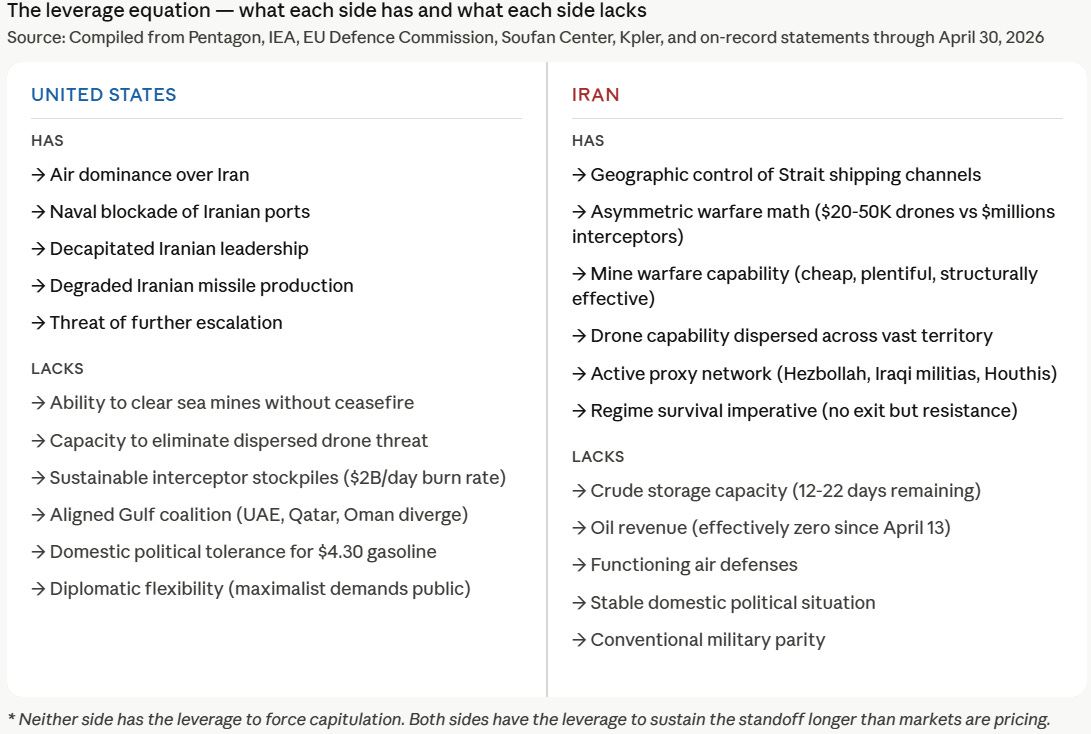
The structural constraint cuts deeper than any of these specific limitations. The U.S. is reportedly spending approximately $2 billion per day on the war. It is using Patriot and THAAD interceptor missiles costing millions of dollars each to shoot down Iranian Shahed drones costing $20,000 to $50,000 to build. The European Union’s Defence Commissioner stated on March 6 that U.S. military costs were overstretched and that there were shortages of key missile stocks. U.S. main bases at Brest and Toulon in France are “nearly empty” due to mobilization toward the Middle East. Iran’s strategic doctrine — explicitly stated by analysts at the Soufan Center — is to deplete U.S. interceptor stockpiles rather than win conventional engagements. The longer the war continues, the more this asymmetry favors Iran.
This is not a secret strategic insight. It is the basic math of the conflict.
There is a second constraint worth stating plainly: the regional infrastructure damage now cuts against escalation. Every additional strike on Iranian energy infrastructure deepens damage that, as Saturday’s piece documented, already takes years to repair. Every Iranian retaliatory strike on Gulf energy infrastructure adds to the $25 billion-plus in damage that Qatar’s energy minister has said sets the region back “10 to 20 years.” The U.S. and its allies have an interest in stopping the damage. Iran has an interest in continuing to threaten it. That asymmetry favors Iran’s bargaining position, not Washington’s.
THE DRONE PROBLEM — IRAN’S PERMANENT VETO
The drone capability deserves its own treatment because it is the structural feature of this conflict that the market most underestimates.
Iran’s drone arsenal is not concentrated at a small number of identifiable bases that air strikes can eliminate. It is dispersed across thousands of square miles of Iranian territory — manufactured in scattered workshops, stored in caves and underground facilities, transported by mobile launchers, and capable of being launched from positions that change daily. The 86% reduction in drone attacks since February reflects degradation of Iran’s launch tempo, not elimination of its inventory or production capacity. The remaining capability is sufficient to threaten any Strait transit indefinitely.
Estimates of mine-clearing timelines for the Strait of Hormuz vary widely. Public analysis ranges from weeks for a basic shipping channel to many months for full strait clearance, depending on how many mines Iran has actually deployed, what types, and whether Iran cooperates with the operation. The Pentagon has not publicly committed to a specific timeline. But mine-clearing is, in some respects, the easier problem. Mines are static. They can be located, mapped, and removed. Drones are not.
Eliminating Iran’s drone threat to commercial shipping in the Strait would require one of two things: sustained intelligence operations to find and destroy each individual launch site, storage facility, and production workshop across Iranian territory — an effort with no realistic timeline given the dispersion involved — or ground operations on a scale that would require committing tens of thousands of U.S. troops to operations across Iran.
The second option is not politically feasible. The American public has shown sustained low tolerance for ground operations in the region since Iraq. Congressional pushback on the war is growing. Senate opposition to extended war powers authorization is real and increasing. The administration itself has shown reluctance to commit ground forces despite rhetorical escalation — the canceled Witkoff/Kushner Tehran trip, the multiple “paused” strikes on Iranian energy infrastructure, and Trump’s repeated walk backs of escalation threats all suggest internal awareness of the political ceiling.
This is the structural feature that gives Iran what amounts to control of Strait passage, both currently and for the fore-seeable future. Even if a ceasefire is reached and mines are cleared and the U.S. blockade is lifted and insurance returns and stranded vessels are repositioned — Iran retains the ability to close the Strait again at any time by deploying its drone capability against shipping. This is not a one-time decision Iran made in March. It is a decision Iran can make repeatedly, at any point, including months or years after any putative resolution.
The world will eventually develop more effective defenses against the kind of asymmetric drone capability Iran has demonstrated. That is a multi-year technological and strategic problem, not something the next ceasefire resolves. For the foreseeable future, the working assumption has to be that Iran controls the Strait at its discretion — even after the current crisis is formally settled, whenever and however that occurs.
This changes how to interpret the negotiation. Iran is not negotiating from weakness despite its acute economic distress. Iran is negotiating from a position of structural permanent leverage that the U.S. has no realistic military option to neutralize. Tehran knows this. Washington knows this. The market does not appear to have priced this.
WHAT IRAN ACTUALLY HAS — AND WHAT IT DOESN’T
Iran is in genuine economic distress. Kpler tracking data, as of late April, shows Iran has 12 to 22 days of crude oil storage capacity remaining at current production rates. Kharg Island — which handles 90% of Iran’s crude exports — was at 74% storage capacity on April 20 and building rapidly. Iran is reactivating idle tankers as floating storage to buy time. U.S. Treasury Secretary Bessent stated on April 22 that Kharg Island storage would be full “in a matter of days, at which point the fragile Iranian oil wells will be shut in.”
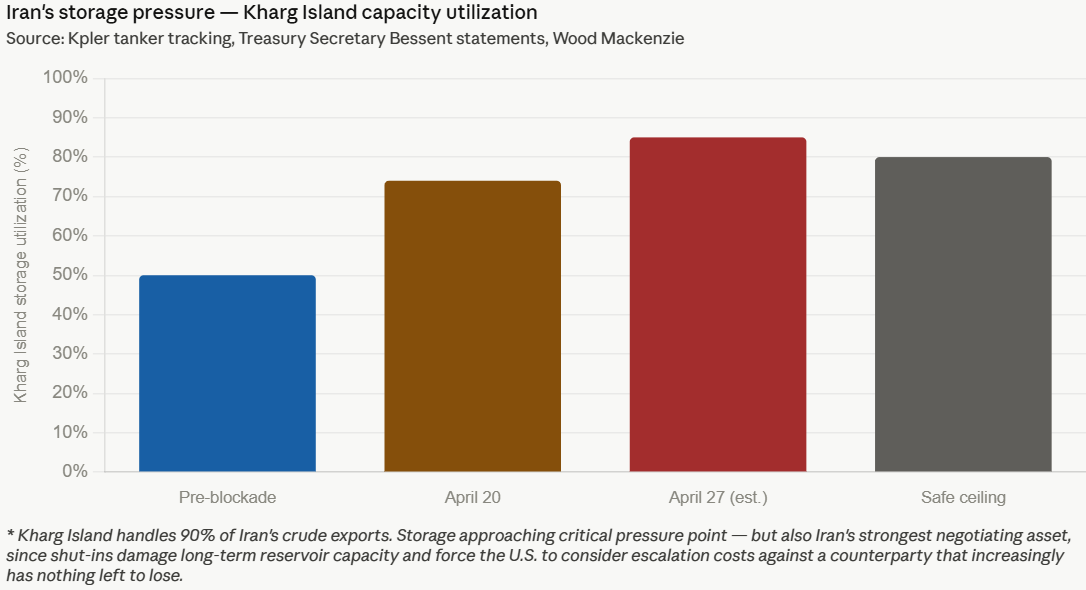
Production shut-ins risk long-term reservoir damage. Iranian oil revenue, which had paradoxically risen since the Strait closure as Iran took advantage of higher prices, is now effectively zero. The rial is under severe pressure. Domestic instability remains acute — a January 2026 uprising killed tens of thousands of protesters and required foreign Iraqi militia fighters to suppress. Trump posted on Truth Social that there is “tremendous infighting and confusion within Iran’s leadership. Nobody knows who is in charge, including them.”
Iran almost certainly wants a deal. The economic pressure is real and acute. The longer the blockade continues, the more permanent damage occurs to oil production capacity that takes years to rebuild. The regime’s revenue base is collapsing.
But wanting a deal is not the same as accepting any deal. The structural reasons Iran cannot accept the terms currently being demanded are durable, and they sit beneath whatever the current leadership’s specific calculations may be.
The first structural reason is regime survival. Revolutionary regimes that have killed protesters and brought in foreign militias to suppress their own population have demonstrated, through their actions, that they prioritize regime continuity over population welfare. Capitulation on U.S. terms — abandoning enrichment, surrendering enriched uranium, ending support for proxy networks, opening the Strait without securing the lifting of the U.S. blockade — would represent a political catastrophe that the IRGC-dominated leadership likely cannot survive. The leadership that took over after Khamenei’s death derives its legitimacy from resistance. A regime that capitulates loses both its external posture and its internal justification simultaneously.
The second structural reason is more important and less commonly discussed. It is the lesson of the past quarter-century of nonproliferation history.
THE POST-NORTH KOREA LESSON
Any rational Iranian leadership, observing the past 25 years of how the United States has treated states with and without nuclear weapons, would draw a specific conclusion.
Iraq under Saddam Hussein had no nuclear weapons. The United States invaded, and the regime was destroyed. Libya under Muammar Gaddafi had a nuclear weapons program. Gaddafi gave it up in exchange for Western reintegration in 2003. The regime was destroyed by Western military intervention in 2011. North Korea developed nuclear weapons. The regime remains intact. The United States negotiates with it as a de facto nuclear state.
The pattern is not subtle. States that give up their nuclear programs at U.S. demand are subsequently destroyed. States that complete their nuclear programs are not.
Iran’s leadership is now being asked to give up uranium enrichment by an administration that has explicitly called for regime change. From any rational analytical perspective in Tehran, accepting these terms means accepting the same fate as Iraq and Libya. Refusing means continued economic pain but preserved strategic deterrence — and the war itself has reinforced this calculus rather than weakening it. The war began with U.S. and Israeli air strikes against a state without nuclear weapons. The strikes killed the Supreme Leader. They destroyed the IRGC headquarters. They damaged South Pars and Lavan and other infrastructure. They could not have happened against a nuclear-armed state.
This is the structural reason the negotiation gap on enrichment cannot close through additional pressure. The United States is demanding that Iran give up the one thing the post-North Korea precedent has taught it is essential to long-term survival. From Tehran’s perspective, the demand is not negotiable on principle — and the more pressure Washington applies, the more the demand confirms the lesson.
The implication for the conflict’s resolution is direct. Whatever ceasefire eventually emerges, Iran is more likely to pursue nuclear weapons capability after the war than before. The administration’s current campaign may delay Iranian weaponization. It cannot prevent it, and it has dramatically strengthened the strategic case for it.
That is a longer-term concern beyond the scope of this thesis. But it shapes near-term negotiation dynamics. Iran will not give up enrichment for any economic relief package the United States can plausibly offer. The negotiation that does eventually conclude will require either U.S. acceptance of continued Iranian enrichment under monitoring — which the administration’s public commitments make difficult — or extended duration of the current conflict.
THE NEGOTIATION GAP
Direct talks between U.S. and Iranian negotiators in Islamabad on April 11 collapsed without progress. The reason was specific. The United States demanded a 20-year moratorium on Iranian uranium enrichment. Iran offered five years. The United States demanded removal of Iran’s stockpile of highly enriched uranium — approximately 440 kilograms enriched to 60% purity — from Iranian territory. Iran refused, offering instead a “monitored process of down-blending” within Iran. The United States demanded restrictions on Iran’s ballistic missile program. Iran has called this “non-negotiable.”
These are not gaps that close through additional pressure. They are gaps that reflect fundamentally different conceptions of what is being negotiated. The United States wants Iran to give up the capacity to develop nuclear weapons and the means of delivering them. Iran — having absorbed the lesson of how nuclear and non-nuclear states have been treated — wants to retain those capabilities while securing relief from the blockade.
The structure of the negotiation reveals the leverage problem. Iran is willing to make concessions — five years of enrichment moratorium, downblending of stockpiles, IAEA monitoring — that would, in any prior context, have been welcomed as substantial. The United States is rejecting these concessions because the administration has made maximalist demands public and cannot accept anything less without political cost. Trump has explicitly called for regime change. Multiple statements have demanded Iranian “unconditional surrender.” Each public commitment narrows the space for compromise. This is not a critique of intent. It is an observation about how political constraints affect outcomes.
There is one additional constraint on the U.S. side that has shown up repeatedly in the pattern of escalation and walkback. The administration has demonstrated sensitivity to market reactions in its decision-making. The April 8 ceasefire announcement came as oil was spiking. The April 26 Iranian proposal received serious consideration when markets were rallying on resolution headlines. Multiple “paused” strikes on Iranian energy infrastructure occurred after equity sell-offs. This pattern suggests that sustained escalation is constrained not only by political and military factors but by the administration’s apparent treatment of market behavior as a barometer for decision-making. This argues against decisive U.S. action — but it also argues against quick resolution, because each cycle of escalate-and-retreat is itself the structural feature that produces the frozen conflict pattern rather than decisive action in either direction.
The mediating nations — Pakistan, Oman, Qatar, Turkey, Egypt — are working to bridge gaps that may not be currently bridgeable or bridgeable in the near term. None of this is producing breakthrough.
The reason is not lack of effort. It is that the gap between what each side requires for political survival is genuinely larger than the diplomatic space available to bridge it.
THE FOUR PATHS — AND THE FIFTH ONE THAT’S MOST LIKELY
There are five plausible paths from current conditions. Each has implications for the energy pillar and therefore for the framework.
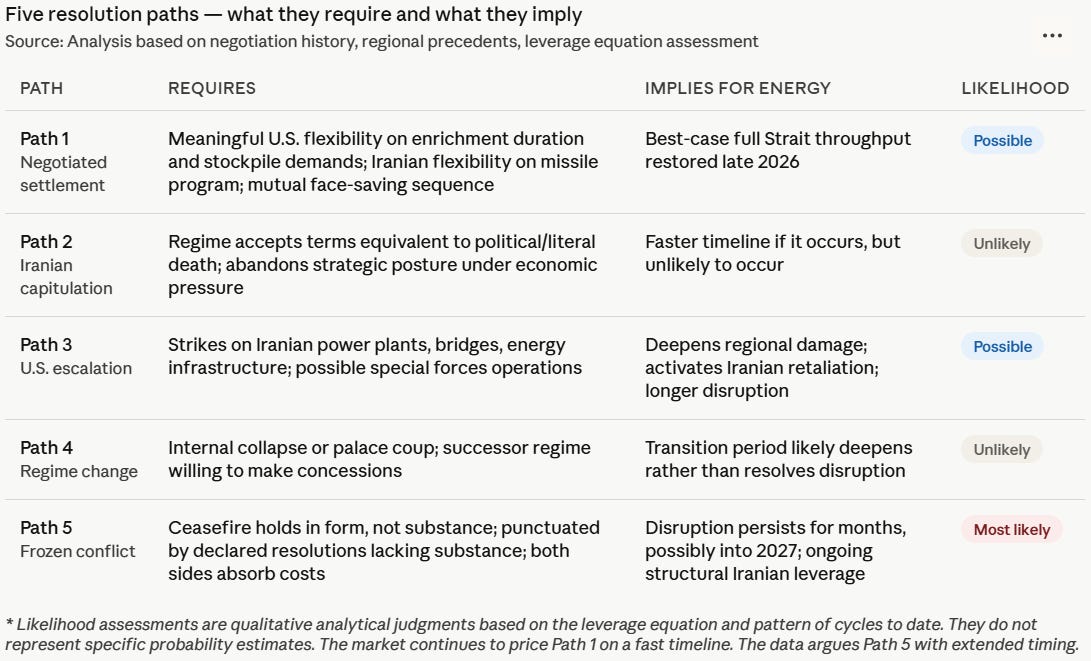
Path one is negotiated settlement on terms acceptable to both sides. This requires meaningful U.S. flexibility on the enrichment duration and stockpile demands, meaningful Iranian flexibility on missile program restrictions, and a sequencing arrangement that allows both sides to claim victory. Even in the optimistic case, mine-clearing takes time once a ceasefire is reached and the drone problem persists indefinitely. Best-case timeline for full Strait throughput restoration: mid-to-late 2026. The market is not pricing this timeline.
Path two is Iranian capitulation under economic pressure. Storage runs out within weeks. Production shut-ins force regime decisions. The argument against this path is structural: capitulation likely equals regime death from the perspective of Iran’s leadership. The post-North Korea lesson reinforces this calculus rather than weakening it.
Path three is U.S. escalation to limited strikes. Trump has repeatedly threatened “short and powerful” strikes on Iranian power plants, bridges, and energy infrastructure. The administration’s pattern of escalation followed by walkback under market pressure suggests sustained escalation is unlikely. Even if it occurs, escalation deepens regional infrastructure damage and activates Iranian retaliation rather than producing capitulation.
Path four is regime change in Iran. Trump has explicitly called for it. UK Prime Minister Starmer has rejected the concept of “regime change from the skies.” The IRGC-dominated leadership controls the security apparatus. Foreign Iraqi militias suppressed the January 2026 uprising. A successor regime, if it emerged from internal collapse, may be more hardline rather than less. This is not a market-relevant scenario for current pricing.
The fifth path is the one the data points toward most strongly. Frozen conflict. Ceasefire holds in form but not in substance. Negotiations continue without breakthrough. The Strait remains effectively closed or limited even after any putative reopening. The U.S. blockade continues, possibly easing in stages but not lifting fully. Both sides absorb costs without decisive movement. Iran adapts — floating storage, ship-to-ship transfers, evasive shipping. U.S. allies adapt — Saudi pipeline expansion (now itself attacked), Russian oil substitution, strategic reserve drawdowns. The disruption persists for months, possibly into 2027. And critically: even after this round resolves, Iran retains the drone capability to disrupt Strait passage at any future moment of its choosing.
Frozen conflict in this case is most likely to be punctuated by periodic declarations of progress or partial agreement that lack substantive content — consistent with the administration’s documented pattern in past trade and diplomatic negotiations. The 2018 North Korea summit produced a “no longer a nuclear threat” declaration despite no actual denuclearization. The China Phase One trade deal was largely declared rather than implemented. NAFTA was renegotiated into USMCA, which preserved most of the original structure under a different name. In each case, the pattern was the same: maximalist public demands, eventual declaration of victory on terms that did not meet those demands, and movement to the next issue. Markets received the resolution as a positive signal regardless of substance. Such declarations may produce temporary market relief without changing the underlying structural reality. The April 8 ceasefire announcement, which preceded continued blockade and ongoing infrastructure damage, may be the template for what is coming.
The market is pricing path one on a fast timeline. The data argues path five with extended timing — likely punctuated by exactly the kind of declared resolutions that look like path one but produce path five outcomes — followed by ongoing structural Iranian leverage that does not disappear with any ceasefire.
WHAT THIS MEANS
The leverage equation, examined honestly, points in one direction. Neither side has the leverage to force the other to accept terms that would mean political death. Both sides have the leverage to sustain the current standoff longer than the market is pricing. The structural features of the conflict — the asymmetric warfare math, the drone capability that cannot be eliminated short of politically infeasible ground operations, the regime survival calculation in Tehran reinforced by the post-North Korea lesson, the political constraints in Washington including market sensitivity, the divergent interests of major third parties — all point toward duration rather than resolution.
This is not a forecast of imminent escalation or imminent collapse. It is a description of why the current situation persists. The market keeps rallying on the assumption that the structural features will yield to short-term pressure. The structural features have proved durable across multiple cycles of pressure already. There is no reason to expect the next cycle to produce different outcomes than the last four.
There is a further implication worth stating plainly. Even when this round of the conflict eventually resolves — whenever and however that occurs — Iran will retain the drone capability that gives it permanent leverage over Strait transit. The next closure is not a hypothetical. It is a future Iran can execute at any time. Markets pricing a clean resolution and return to pre-war conditions are pricing a state that may not be achievable for years, if ever.
The framework does not require the United States to “win” or for Iran to “win” or for either to “lose”. It requires only that the disruption persist. The leverage equation suggests it will.
That is what the market is mispricing.
The full framework — including the seven pillars and the deep dive series — is in The Framework: A Reader’s Guide: thetellstoffel.substack.com
Part 1 — “The Strait That Doesn’t Reopen” — published Saturday.
Nothing published here constitutes investment advice. These are one individual’s probabilistic assessments, offered for informational purposes only. Readers should consult qualified financial advisors before making investment decisions.